
多尺度差异化气候减缓路径
-
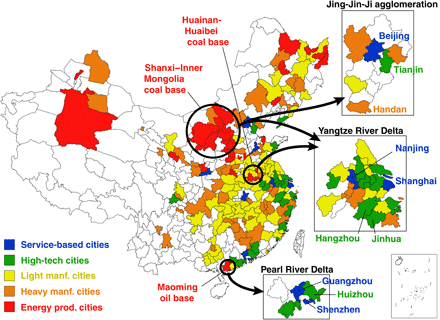
City-level climate change mitigation in China
As national efforts to reduce CO 2 emissions intensify, policy-makers need increasingly specific, subnational information about the sources of CO 2 and the potential reductions and economic implications of different possible policies. This is particularly true in China, a large and economically diverse country that has rapidly industrialized and urbanized and that has pledged under the Paris Agreement that its emissions will peak by 2030...
-
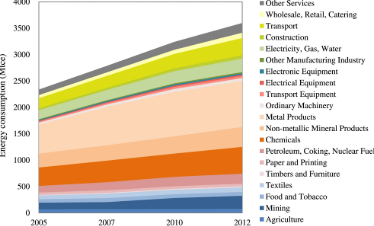
China's Energy Consumption in the New Normal
Energy consumption is one of main reasons for global warming and highly correlated with economic development. As the largest energy consumer worldwide, China has entered a new economic development model—the “new normal.” This study aims to explore the pattern shift in China's energy consumption growth in this new development phase. We use structural decomposition analysis and environmentally extended input‐output analysis to dec...
-
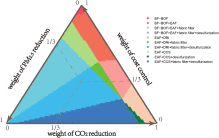
Multi-objective analysis of the co-mitigation of CO2 and PM2.5 pollution by China's iron and steel indu
China has experienced serious fine particulate matter (PM 2.5 ) pollution in recent years, and carbon dioxide (CO 2 ) emissions must be controlled so that China can keep its pledge to reduce CO 2 emissions by 2030. The iron and steel industry is energy intensive and contributes significantly to PM 2.5 pollution in China. The simultaneous reduction of CO 2 emissions and PM 2.5 pollution while minimizing the total mitigation costs remains...
-
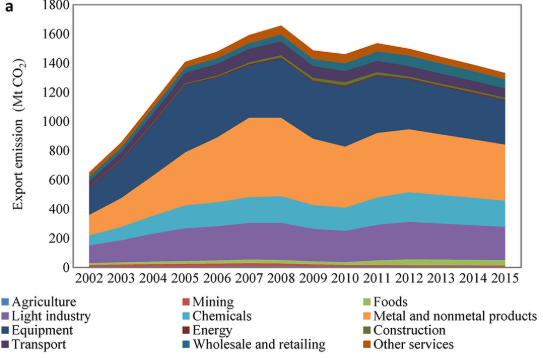
China's “Exported Carbon” Peak: Patterns, Drivers, and Implications
Over the past decade, China has entered a “new normal” phase in economic development, with its role in global trade flows changing significantly. This study estimates the driving forces of Chinese export‐embodied carbon emissions in the new normal phase, based on environmentally extended multiregional input‐output modeling and structural decomposition analysis. We find that Chinese export‐embodied CO 2 emissions peaked in 2008...
-
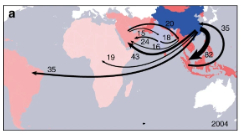
The rise of South–South trade and its effect on global CO2 emissions
Economic globalization and concomitant growth in international trade since the late 1990s have profoundly reorganized global production activities and related CO 2 emissions. Here we show trade among developing nations (i.e., South–South trade) has more than doubled between 2004 and 2011, which reflects a new phase of globalization. Some production activities are relocating from China and India to other developing countries, particular...
-
CEADs研究:南-南贸易迅速增长、加强南-南合作是应对全球气候变化减排的有效途
自20世纪90年代末以来,经济全球化加速了国际贸易的增长,并对全球生产活动及产生的二氧化碳分布产生了深刻影响。亚洲发展中国家作为主要制造中心和出口中心,承接发达国家的产业转移,向后者出口制成品以满足其对廉价商品的大量需求,虽形成贸易盈余但因此增加全球碳排放。全球金融危机以来,世界贸易格局正在经历深刻...
-
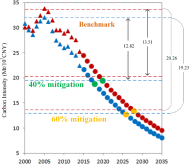
How modifications of China's energy data affect carbon mitigation targets
Frequent modifications to energy statistics have led to considerable uncertainty in China's ability to achieve its carbon mitigation targets. Here, we quantitatively measure the impact of energy data revisions on China's ability to achieve its mitigation targets. Our results indicate the following effects of data revisions: 1. Mitigation challenges have increased by 5%, and the achievement of national mitigation targets (as well as inter...
-
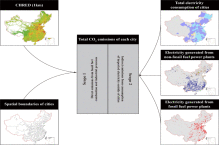
Local strategies for China's carbon mitigation: An investigation of Chinese city-level CO2 emissions
This paper provides a systematic analysis that identifies the driving forces of carbon dioxide (CO 2 ) emissions of 286 Chinese prefecture-level cities in 2012. The regression analysis confirms the economic scale and structure effects on cities' CO 2 emissions in China. If China's annual economic growth continues at the rate of 7%, CO 2 emissions will increase by about 6% annually. In addition, climate conditions, urbanization and public...
-
The comprehensive environmental efficiency of socioeconomic sectors in China: An analysis based on a no
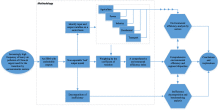
The increasingly high frequency of heavy air pollution in most regions of China signals the urgent need for the transition to an environmentally friendly production performance by socioeconomic sectors for the sake of people's health and sustainable development. Focusing on CO 2 and major air pollutants , this paper presents a comprehensive environmental efficiency index based on evaluating the environmental efficiency of major socioecon...
-
Targeted emission reductions from global super-polluting power plant units
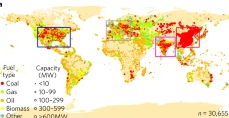
There are more than 30,000 biomass- and fossil-fuel-burning power plants now operating worldwide, reflecting a tremendously diverse infrastructure, which ranges in capacity from less than a megawatt to more than a gigawatt. In 2010, 68.7% of electricity generated globally came from these power plants, compared with 64.2% in 1990. Although the electricity generated by this infrastructure is vital to economic activity worldwide, it also pr...