
气候风险评估与适应路径
-
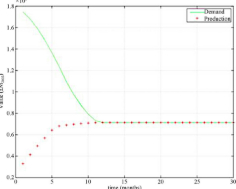
Vulnerability of London’s Economy to Climate Change: Sensitivity to Production Loss
A variant of the Adaptive Regional Input-Output model (ARIO) has been developed to explore the sensitivity of the London economy to loss of production capacity in sectors affected by climate change related damage. The model is designed for linking to an Event Accounting Matrix (EAM) produced by climate and engineering teams, and then follow this damage through direct and indirect losses in the economy during a recovery process that is ei...
-
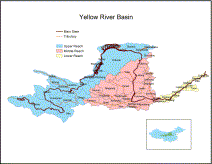
Assessing regional virtual water flows and water footprints in the Yellow River Basin, China: A consump
The Yellow River, the second longest river in China, is facing increasing water scarcity due to rising water consumption of a fast growing economy and an increasingly urbanized population with water-intensive consumption patterns. The Yellow River Basin (YRB) is divided into three regions: the upper, middle and lower reaches; each with very different characteristics in terms of water resources, economic structure and household income and...
-
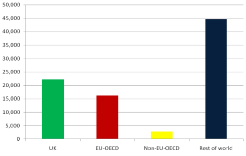
Spatially Explicit Analysis of Water Footprints in the UK
The Water Footprint, as an indicator of water consumption has become increasingly popular for analyzing environmental issues associated with the use of water resources in the global supply chain of consumer goods. This is particularly relevant for countries like the UK, which increasingly rely on products produced elsewhere in the world and thus impose pressures on foreign water resources. Existing studies calculating water footprints ar...
-
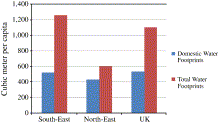
Assessing regional and global water footprints for the UK
The concept of the water footprint has been recently introduced as an important indicator for human-induced water consumption. The water footprint is defined as the total volume of water used during production and consumption of goods and services as well as direct water consumption by humans. Water is not only consumed directly but also indirectly in production processes. Therefore, calculating the water footprint enables us to quantify...
-
Environmental implications of urbanization and lifestyle change in China: Ecological and Water Footprin
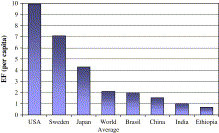
Since the open door policy in 1978 China has undergone enormous economic and social changes making China to be one of the largest economies and consumers of resources in the world. The pronounced differences in income and lifestyles especially between urban and rural China were also part of China's economic rebirth. This paper explores current trajectories and scenarios for urbanization and lifestyle changes and other important socio-eco...
-
A new and integrated hydro-economic accounting and analytical framework for water resources: A case stu
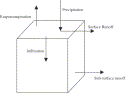
Water is a critical issue in China for a variety of reasons. China is poor of water resources with 2300m 3 of per capita availability, which is less than 1/3 of the world average. This is exacerbated by regional differences; e.g. North China's water availability is only about 271m 3 of per capita value, which is only 1/25 of the world's average. Furthermore, pollution contributes to water scarcity and is a major source for diseases, part...
-
Assessment of regional trade and virtual water flows in China
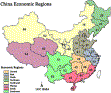
The success of China's economic development has left deep marks on resource availability and quality. Some regions in China are relatively poor with regards to water resources. This problem is exacerbated by economic growth. Flourishing trade activities on both domestic and international levels have resulted in significant amounts of water withdrawal and water pollution. Hence the goal of this paper is to evaluate the current inter-regi...